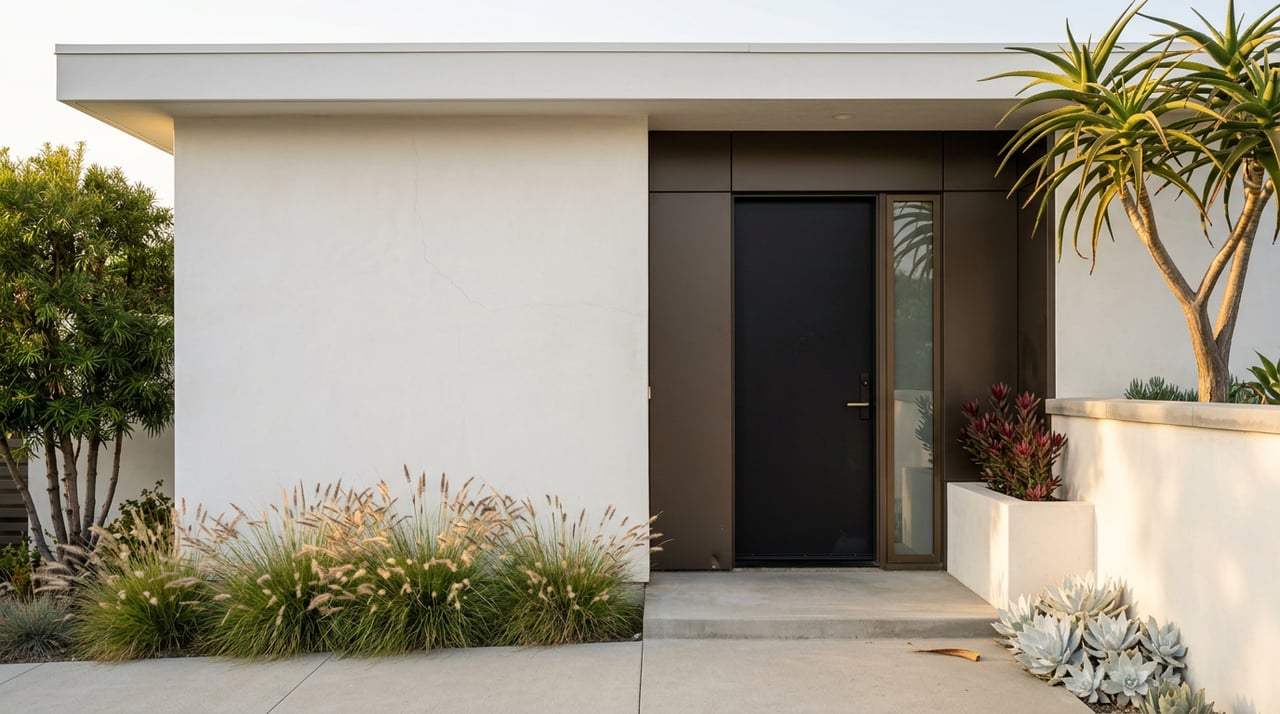
In November 2025, an application landed at the Los Angeles Department of City Planning for a Mar Vista lot most people would walk past without a second look. The site at 3252 S. Barrington Avenue holds a single 1940s house. The filing does not treat it as one house. It calls for demolishing the structure and subdividing the parcel into five lots, each slated for a new three or four bedroom home designed by architect Tracy A. Stone. The application was assigned to city staff in mid-December and, as of the most recent public record, sits on hold. It is not the first project like it on that stretch of Barrington. It will not be the last.
That detail matters more than it looks like it should, because it is the quiet mechanism behind a number every Westside buyer has already seen: Mar Vista's median sale price climbing sharply this year while Venice's appears to be pulling in the opposite direction. Read at face value, that gap tells a simple story about which neighborhood is heating up and which one is cooling off. Read against what is actually closing on the ground, it tells a story about what each number is counting.
A pattern with a paper trail
The Barrington filing is one entry in a longer running project that has been reshaping small pockets of Mar Vista's housing stock for over a decade, going back to at least 2013 when one of the first eight-home small lot subdivisions in the neighborhood was reported. The recent additions include:
- Barrington 10, at 3230-3238 S. Barrington Avenue. Ten homes ranging from 1,700 to 2,200 square feet, designed by KTGY with black stucco and white siding, on a site entitled to an entity managed by Yaron Levy and filed under applicant Sapphire Development V, LLC.
- The 3252 S. Barrington proposal, filed in November 2025, calling for five new homes between 1,443 and 1,765 square feet on the site of a razed 1940s house, one block from two similar projects already delivered.
- Pacific 5, at the corner of Centinela and Pacific avenues, one block south of Venice Boulevard. Five homes designed by MORÈ Architects, with grounds by NAVA Landscape Architecture.
- A six-home project at McLaughlin and Charnock, which replaced a 1950s fourplex. Design Universal designed the homes, and the property was entitled for development by Lewis Futterman.
- A second McLaughlin project, at 3601 S. McLaughlin, also on the site of a razed fourplex, again designed by Design Universal under the same entitlement holder.
- Seven homes proposed at 3671 Inglewood Boulevard, filed as recently as March 2026 by applicant Dream Bigger Acquisitions 6, LLC, using factory-built construction and recent changes to state housing law that make this kind of subdivision easier to pursue on a standard residential lot.
This is not one developer's opportunistic swing. It is a repeatable formula that keeps getting applied to the same handful of blocks, because the math keeps working. Five or ten entitlements carved out of one parcel are worth more collectively than one house on one lot, and every resulting home enters the closed sales record as new construction, priced like new construction, not like the 80-year-old bungalow or the aging fourplex it replaced.
The number everyone is comparing
Here is what a buyer scanning headline data actually sees. As of June 30, 2026, Zillow's home value index put Mar Vista's average home value at $1,855,319, up 6.1% over the previous year. The sales data underneath that figure shows why the neighborhood keeps beating the broader market: in March 2026, Mar Vista's median sale price stood at $2.1 million, up 8.2% from a year earlier, according to Redfin. Price per square foot for that same month came in at $1,220, up 11.5% year over year. Homes sold faster too, averaging 35 days on market compared to 55 the year before, though the total number of homes that changed hands fell to 47 from 78.
Venice tells two different stories depending on which boundary you're reading. Over the three months ending in June 2026, the core Venice market posted a median sale price of $2.0 million, essentially flat against the same period a year earlier, with homes selling in 48 days on average compared to 54, and 120 homes closing in June against 122 the year before. But Redfin's narrower Venice Beach boundary, covering the three months ending in March 2026, showed a median sale price of $1.9 million, down 26.0% year over year, even as price per square foot in that same window rose 37.4%. Only ten homes sold in that boundary during March, up from three the year before.
| Metric | Mar Vista (as of Mar 2026) | Venice, core (as of Jun 2026) | Venice Beach boundary (as of Mar 2026) |
|---|---|---|---|
| Median sale price | $2.1M, up 8.2% YoY | $2.0M, down 0.035% YoY | $1.9M, down 26.0% YoY |
| Price per sq ft | $1,220, up 11.5% YoY | $1,270, up 0.2% YoY | $2,020, up 37.4% YoY |
| Homes sold (month) | 47 (down from 78) | 120 (down from 122) | 10 (up from 3) |
| Days on market | 35 (down from 55) | 48 (down from 54) | 101 (up from 68) |
A price per square foot up more than a third while the median sale price falls by more than a quarter is not two contradictory readings of the same market. It is two readings of a much smaller and differently composed set of houses. A boundary that closes ten sales in a quarter will swing hard based on which specific homes happen to trade, and a jump from three sales to ten is itself part of the story. Whatever mix of houses sold this year was not the mix that sold last year.
Why Mar Vista's own number isn't any cleaner
The same logic that scrambles Venice's numbers is quietly at work in Mar Vista too. The projects listed above did not scatter across the neighborhood at random. Several sit within a few blocks of each other on Barrington Avenue alone, with more clustered around Centinela, Pacific, and McLaughlin. As those units deliver and eventually resell, a growing share of Mar Vista's closed sales each quarter are new construction homes on subdivided lots running roughly 1,443 to 2,200 square feet by plan, not original postwar bungalows sitting on a full-size parcel.
New construction almost always commands a higher price per square foot than 80-year-old original stock, independent of whatever the underlying land is doing. That premium shows up first in the price-per-square-foot column, which is exactly what the Mar Vista figures reveal: price per square foot up 11.5% for the year, running ahead of the 8.2% gain in the median sale price itself. The gap between those two numbers is a reasonable stand-in for how much of this year's movement reflects a genuinely more valuable housing stock trading hands, versus how much reflects more new construction simply entering the sample.
It also helps to know that Mar Vista's median is stitching together at least two separate stories that have nothing to do with each other. In Westdale, a turnkey three-bedroom postwar bungalow typically trades between $1.9 million and $2.4 million, a renovation-and-condition story on a standard lot. Up on the Hilltop, entry-level homes start closer to $3.2 million, with custom modern builds well above that, a scarcity story tied to lots that average around 7,500 square feet, roughly a quarter larger than the typical Westside parcel. The Barrington corridor's contribution to the median is neither of those. It's a unit-count story: more homes closing per original parcel, at new-construction pricing, pulling the average upward without any single comparable house actually appreciating 8% in a year.
What to actually check before comparing two neighborhoods
- Ask whether recent comps on a given block are original single-family homes or small lot new construction. Assessor parcel records will show a subdivision date and the original lot size before it was split.
- Confirm which boundary a "Venice" or "Mar Vista" figure is drawn from before comparing it against another source. Sub-neighborhood boundaries a few blocks apart can produce very different numbers in the same quarter.
- Look at the sale count behind any percentage swing, not just the percentage itself. Ten sales, or three, is a sample, not a market.
A few questions worth asking directly
Does a rising Mar Vista median mean the original bungalows themselves are worth more? Partly. Renovated original homes have appreciated, but a meaningful share of this year's gain traces back to new small lot construction entering the closed-sales mix at new-construction pricing, on lots that were once counted as a single sale.
How does Mar Vista's per-square-foot pricing really compare to Venice's? Mar Vista typically runs in the $1,150 to $1,350 per square foot range. Venice's most sought-after pockets, like the streets closest to Abbot Kinney, can top $2,000 per square foot for a renovated home. That premium describes a narrow slice of Venice, not its neighborhood-wide baseline, which is part of why the two markets look further apart in casual comparisons than they are in practice.
Are any of these small lot projects replacing rent-stabilized housing? Yes. Two of the Mar Vista projects, at McLaughlin and Charnock and at 3601 S. McLaughlin, razed 1950s fourplexes to make way for new single-family construction. Buildings built before October 1978 in Los Angeles fall under the city's Rent Stabilization Ordinance. Once that older structure is gone and replaced with new single-family stock, both the rent-stabilization overlay and its associated disclosure requirements no longer apply to future sales on that parcel.
Comparing neighborhoods on median price alone treats every closed sale as interchangeable. Mar Vista's numbers this year say otherwise, and so do Venice's. If you're weighing one against the other, or trying to understand what a specific block's recent sales actually tell you about value, that's a conversation worth having with someone who tracks these filings block by block, not just the headline figure. Shelton Wilder is available to schedule a private consultation and walk through what's actually behind the comps on your street.